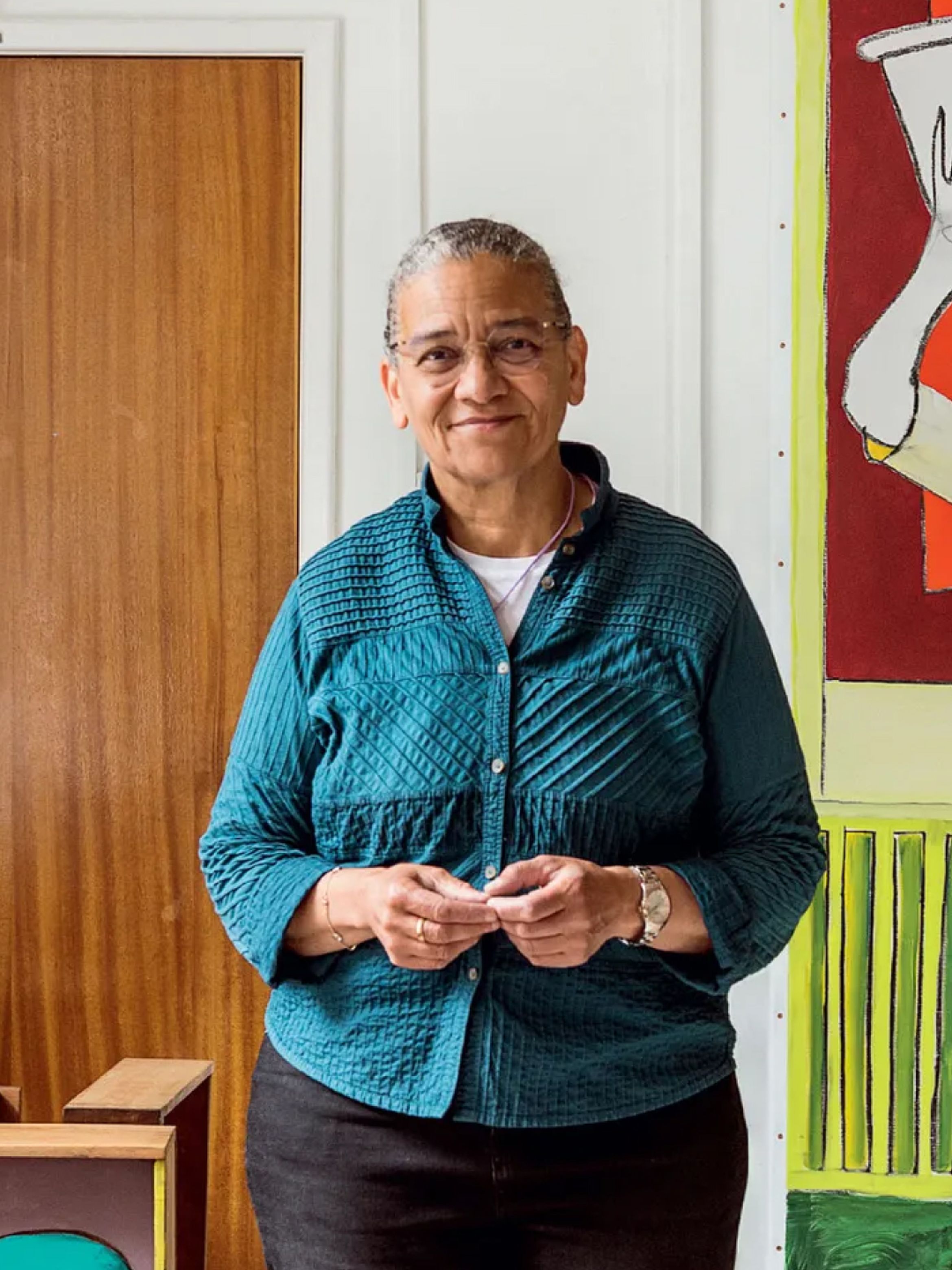
Mind-bending compositions of line and colour have made Bridget Riley one of the most famous living British artists.
“I just love structure. The argument of structure. And the emotional volume that it can present.”
Bridget RileyBorn 1931 in London, Bridget evacuated to Cornwall with her mother, sister and aunt when World War II began. Her father was sent to fight. With no school to attend and stunning coastlines, “there was, in fact, nothing to do but look.”
Bridget moved back to London in the late 1940s to study at Goldsmiths and subsequently the Royal College of Art. She didn’t complete either diploma.
Instead, she taught herself new techniques through observation. By recreating the work of Pointillist painter Georges Seurat – who used densely-packed dots to build representational pictures – Bridget honed a systematic approach to colour and form.
Georges Seurat, The Bridge at Courbevoie, 1886-7
Pink Landscape, 1960
In the 1960s Bridget’s name became synonymous with an emerging movement – Op Art.
Despite being executed in black, white and grey, the compositions created the illusion of many different colours — manipulating the process of perception.
The Kiss, 1961
A Movement in Squares, 1961
Later Bridget introduced new colours from across the spectrum, which she treated with the same mathematical attention to tone, line, depth and volume.
Rattle, 1973
To date, Bridget has made just one sculpture.
“I thought I would make a painting that enveloped you physically. That was a great mistake.”
Bridget immediately turned back to the flat expanse of her greatest love – the canvas.
Throughout her seven-decade career, Bridget’s work has often been categorised as abstract. The label she aligns with most, however, is a simpler one.
“I’m a painter first and foremost. That’s what I do."
Bridget sits within her Continuum sculpture, 1963
By contrast to the spontaneous mark-making of Abstract Expressionism, Bridget's compositions are built on systems.
“You need something to do something with. You can’t explore without an agent.”
In a post-internet world the works take on new meanings. The repeated shapes appear digital, even algorithmic — yet each element is carefully hand painted. This juxtaposition elicits disarmingly emotional results.
Aurum, 1976
Streak, 1979
Equally recognisable on phone screens and museum walls, Bridget’s legacy is tremendous.
“I try to find out what I can look at — what can be seen. Through looking you can learn to see.”
Bridget’s dedication to truly seeing ensures that — in an ever-changing world — there will always be more to paint.
Vein, 1985